The Battle for the Smart Home: A Dad’s Perspective (2026 Edition)
The Battle for the Smart Home: A Dad’s Perspective (2026 Edition)
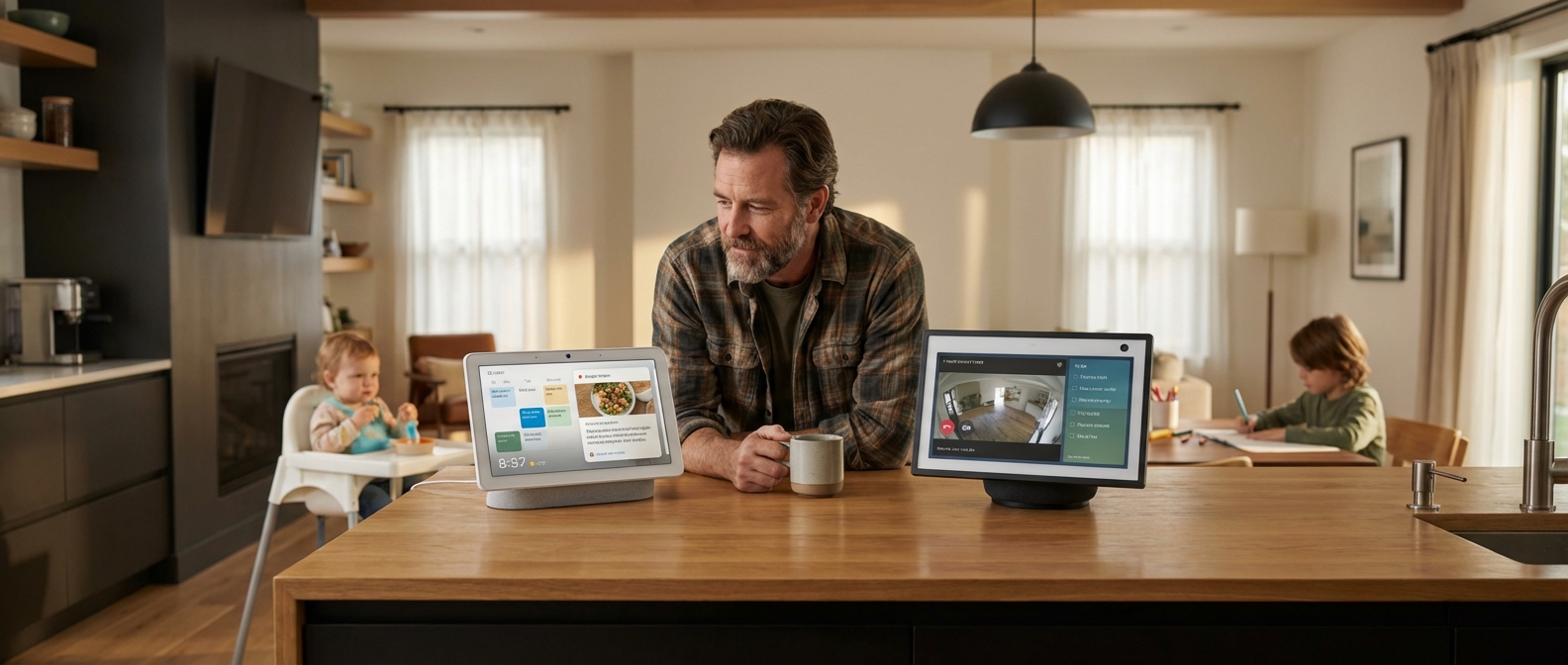
In 2026, the smart home for dads pivots on cognitive load management, not just voice commands. Google Gemini currently dominates in conversational nuance and complex scheduling, acting as a true executive assistant for family logistics. Conversely, Amazon’s upgraded LLM retains the crown for proactive home automation and seamless supply restocking. Your choice depends on whether you need a smarter scheduler (Google) or a more proactive facility manager (Alexa).
The New Baseline: Managing the Chaos
Silence is a luxury you likely traded in years ago. Between the morning school rush, the toddler's tantrums, and the mental load of tracking extracurriculars, your brain is constantly running on fumes. We aren't just comparing gadgets anymore; we are comparing survival tools.
For years, the debate focused on sound quality. That era is over. If you strictly want hardware specs, read our breakdown of The Best Smart Home Speakers of 2026: Ranked & Reviewed for Families. But here, we focus on the "brain."
The real war is Google Gemini vs Alexa AI. We are looking at Large Language Models (LLMs) that must understand context, sarcasm, and the desperate whisper of a parent trying not to wake a sleeping baby.
The AI Shift: Gemini vs. Amazon's LLM
This year, the technology leaped forward. We are stripping away the technical jargon to focus on utility. I don't care about processing power; I care if the assistant can hear me over a crying child and execute a complex command without me repeating it three times.
- Google (Gemini): Google has integrated Gemini deeply into the Nest ecosystem. It excels at "multi-modal" reasoning. You can show your Nest Hub a permission slip, and it will add the date to the calendar and set a reminder to sign it.
- Amazon (Alexa LLM): Amazon focused on "ambient intelligence." It’s less about chatting and more about doing. It predicts your needs—adjusting the thermostat or locking doors—before you even ask.
Here is how they stack up on the metrics that actually matter to fathers:
| Feature | Google Home (Gemini) | Amazon Alexa (Upgraded LLM) |
|---|---|---|
| Conversational Context | Superior. Handles multi-step commands ("Turn off the lights, lock the door, and set the alarm for 7") flawlessly. | Good. Greatly improved, but occasionally stumbles on rapid-fire context switching. |
| "Dad Voice" Recognition | High. Excellent noise cancellation filters out background screaming to hear your command. | Medium. Sometimes requires you to raise your voice over the chaos. |
| Logistics & Shopping | Weak. Good for making lists, but friction-heavy for actual purchasing. | Dominant. Seamlessly reorders diapers, batteries, and essentials. |
| Proactivity | Moderate. Suggests actions based on your calendar and emails. | Excellent. Learns household patterns to automate routines without input. |
Practical Utility Over Gimmicks
The best parenting hacks 2026 offers aren't about flashy screens; they are about automation that works when you are exhausted. If your home is filled with 45+ Modern Dad Gadgets That Actually Save Time & Sanity, you need an AI that ties them together without constant troubleshooting.
Google thinks like a personal assistant: it manages information. Alexa acts like a house manager: it manages the physical environment. Assess your pain points. If you are drowning in schedules, go Google. If you are drowning in chores and logistics, stick with Alexa.
Round 1: The 'All-Knowing' Assistant (Homework & Random Questions)
Round 1: The 'All-Knowing' Assistant (Homework & Random Questions)
In 2026, Google Home secures the victory for answering kids' questions and providing complex homework help, thanks largely to its deep Gemini integration. While Alexa remains competent for basic trivia and spelling, Google excels at multi-turn reasoning and explaining difficult concepts simply. If you want an AI tutor rather than just a voice-activated encyclopedia, Google Home is the superior choice for saving Dad’s sanity.
The Gemini Advantage: Context is King
The days of robotic, one-off answers are behind us. When your child asks a stream of consciousness questions, contextual conversation is the only thing that prevents frustration. Google Home, powered by 2026's advanced Gemini models, holds the context of a conversation significantly longer than Alexa.
If your kid asks, "How big is Jupiter?" and follows up with "And how long is a day there?", Google knows "there" refers to Jupiter. Alexa still occasionally stumbles on these pronouns, forcing you or your child to restate the subject. For a dad trying to cook dinner while managing a curious toddler, Google's ability to hold a thread is invaluable.
Homework Help: Explanations vs. Definitions
This is where the divide widens. Answering kids questions about schoolwork requires more than reading a search snippet.
- Google Home: It acts as a teacher. You can ask, "Hey Google, explain long division to a 9-year-old." It breaks the concept down into steps rather than just giving the result. It can even handle word problems if you read them out clearly.
- Alexa: Amazon has improved, but Alexa often defaults to "Here is a definition from Wikipedia." It gives the what, but rarely explains the how.
If you are looking to upgrade your hardware to handle these newer AI capabilities, check out our review of The Best Smart Home Speakers of 2026 to see which devices have the best microphones for picking up quiet questions.
Feature Breakdown: Knowledge Retrieval
| Feature | Google Home (Gemini Core) | Amazon Alexa (2026 Update) |
|---|---|---|
| Context Memory | Excellent. Remembers topic for 5+ follow-up questions. | Average. Good for 1-2 follow-ups, then often resets. |
| Math Support | Superior. Explains methodology and steps. | Basic. Provides final answers and simple conversions. |
| Source Reliability | High. Cross-references top search results instantly. | Medium. Heavily reliant on Wikipedia and Bing snippets. |
| Language Nuance | High. Understands slang and mumbled phrasing. | Medium. Requires precise diction for complex queries. |
Why This Matters for Dad
When your 5th grader is stuck on a science project about photosynthesis, you don't want to pull out your phone to read an article. You want the room's audio system to bridge the gap.
Google allows you to remain hands-free. It essentially outsources the "Dad, I don't get it" moments to a competent AI assistant. Alexa is still a fantastic smart home controller, but in the arena of knowledge, Google has lapped the field this year.
Google’s Search Dominance
Google Assistant remains the undisputed king of information retrieval because it leverages Google’s massive Knowledge Graph rather than relying on simple keyword matching. For fathers comparing google home vs alexa dad features, Google provides specific, contextual answers to complex questions—like "How do black holes form?"—while Alexa frequently defaults to generic Wikipedia summaries or simply states, "I don't know that one."
The Homework Helper You Actually Need
In 2026, the "Why?" phase doesn't end at toddlerhood; it just evolves into complex science and history questions. Dads managing the morning rush or evening homework sessions need immediate accuracy. Google Home shines here by understanding context. If you ask, "Who is the quarterback for the Chiefs?" and follow up immediately with "How tall is he?", Google knows "he" refers to Patrick Mahomes. Alexa often struggles with this conversational thread, forcing you to repeat the subject.
This capability transforms your smart speaker from a simple timer into a legitimate educational tool. While we evaluate audio quality in our review of The Best Smart Home Speakers of 2026, the intelligence behind the speaker is what saves a dad's sanity during a science fair project.
Knowledge Retrieval Comparison: Google vs. Alexa
When your 8-year-old asks a tough question, the quality of the answer dictates whether you look like a hero or if you have to pull out your phone. Here is how the two assistants stack up in 2026:
| Feature | Google Assistant | Amazon Alexa |
|---|---|---|
| Complex Queries | High. Synthesizes answers from multiple web sources. | Moderate. Often reads the first sentence of a Wikipedia entry. |
| Contextual Follow-up | Excellent. Remembers the previous question's subject. | Low. Usually requires restating the full question. |
| Source Attribution | clear. Cites the specific website or source. | Vague. Often says "Here is what I found on the web." |
| Local Business Data | Superior. Pulls real-time hours/traffic from Maps. | Average. Relies on third-party integrations (Yelp/Bing). |
Why It Matters for Dads
Google's dominance isn't just about trivia; it's about workflow.
- Precise Snippets: Google reads the "Featured Snippet" directly. If you ask, "How long do I grill a steak?", it gives you the time and temperature immediately. Alexa often tries to send a link to your phone app—a friction point no busy dad wants.
- Translation Mode: For bilingual households or language homework, Google’s live interpreter mode is seamless.
- Voice Match Security: Google distinguishes between your voice and your child's, serving age-appropriate answers to the kids while giving you access to your personal calendar or podcasts.
If your priority is having an omnipresent encyclopedia that actually understands natural language, Google Home secures the win.
Alexa’s Conversational Flow
Alexa’s Conversational Flow
Alexa has shifted from a command-response bot to a proactive household companion in 2026, utilizing Amazon’s proprietary large language model (LLM) to prioritize conversational fluidity and context retention. This upgrade makes interactions feel less like querying a database and more like speaking with a helpful, albeit occasionally chatty, assistant, marking a significant divergence in the google home vs alexa dad user experience.
Amazon’s integration of generative AI has solved the "robotic repetition" frustration. You no longer need to repeat the wake word for every sentence. If you ask Alexa to set a timer for the grill, you can immediately follow up with, "And remind me to flip the steaks in five minutes," without missing a beat. The system understands context stacks, meaning it remembers previous queries from minutes—or even hours—ago.
For dads managing a chaotic household, this natural language processing (NLP) is a sanity saver. The assistant can distinguish between your voice and your toddler’s, adjusting its tone and vocabulary accordingly. However, this human-like veneer comes with trade-offs.
The Accuracy vs. Empathy Trade-off
While Alexa dominates in sounding human, it sometimes prioritizes engagement over strict factual precision. If you ask a complex question about history or science for homework help, Alexa might provide a summarized, conversational answer that lacks the granular detail Google provides. It is designed to keep the chat going, not necessarily to act as an encyclopedia.
Here is how the conversational capabilities stack up in 2026:
| Feature | Alexa (2026) | Google Home (2026) |
|---|---|---|
| Context Retention | High. Remembers topic shifts effortlessly. | Medium-High. Good, but requires more specific prompting. |
| Tone & Personality | Warm, empathetic, and occasionally humorous. | Neutral, informative, and strictly professional. |
| Response Latency | Near-instant for commands; slight pause for complex chat. | Consistent speed, optimized for data retrieval. |
| Hallucination Risk | Moderate. May "guess" to maintain flow. | Low. Will cite sources or admit ignorance. |
| Interruption Handling | Excellent. Stops immediately when spoken over. | Good, but sometimes finishes the sentence anyway. |
Practical Application for Dads
The "Let's Chat" mode is where Alexa shines for smart home automation. Instead of memorizing specific syntax like "Turn on Living Room Lights to 50%," you can simply say, "Alexa, it’s too bright in here for movie night." The AI infers the intent, dims the lights, and might even suggest turning on the TV.
However, be wary of the "suggestive selling" creeping into the conversation. Because Amazon’s ecosystem is built on retail, a question about grilling temperatures might end with a prompt to buy a new meat thermometer.
- Pro: It feels like a family member. It can tell bedtime stories that actually make sense and change based on your child's mood.
- Con: It talks too much. Sometimes you just want the weather, not a comment on how nice the sun feels.
- Verdict: If you want a companion that manages the home with personality, Alexa wins. If you want a librarian, stick with Google.
If you are looking to upgrade your hardware to support these new AI features, take a look at our review of The Best Smart Home Speakers of 2026 to see which devices handle the new processing requirements best.
Round 2: Command & Control (Routines and Automation)
Round 2: Command & Control (Routines and Automation)
For the "Sheriff Dad" managing a household, Alexa currently holds the edge in 2026 due to its superior routine triggers and intuitive "Hunche" capabilities. While Google Home offers a cleaner UI for basic tasks, Alexa’s granular control over smart home routines makes locking doors at night and automating security sequences far more reliable for power users who demand precision.
The Matter Standard: A Level Playing Field
It is January 2026, and the device compatibility wars are effectively over. Thanks to universal Matter support 2026, a standard now fully matured, both Google and Amazon communicate seamlessly with virtually every lock, light, and sensor on the market. You no longer buy a bulb based on which assistant you use; you buy it based on quality.
However, connectivity does not equal control. The divergence lies in how the apps let you wield that power. If you are just starting out, you might want to review What is Smart Home Automation? to understand the basics of these protocols.
Alexa: The Logic Workhorse
Amazon’s interface remains utilitarian, but it is a powerhouse for logic. For the dad who wants to ensure the house is secure without lifting a finger, Alexa remains king.
- Complex Triggers: Alexa allows for multiple triggers for a single routine without coding. You can set a sequence that triggers if either the back door opens or motion is detected in the garage.
- Proactive Hunches: In 2026, Alexa's "Hunches" have evolved from annoying suggestions to legitimate automation. If you go to bed and leave the garage door open, Alexa doesn't just tell you; she can be set to close it automatically.
- Sound Detection: Alexa devices can trigger routines based on specific sounds (baby crying, glass breaking) natively, making it a robust customized security tool.
Google Home: The Visual Specialist
Google has made massive strides with its "Script Editor," but its mobile app interface prioritizes aesthetics over density.
- Ease of Access: The tile-based view provides the fastest way to manually toggle a light or check a camera feed.
- Visual Feedback: Google provides better visual confirmation that a command was executed, which is vital when you are troubleshooting.
- Limitations: Creating complex "If/Then" scenarios often requires using the web-based script editor rather than the app, which adds friction for the average parent.
Feature Breakdown: Automation Capabilities
| Feature | Google Home | Amazon Alexa | The "Sheriff Dad" Winner |
|---|---|---|---|
| Routine Complexity | Moderate (High via Web Scripting) | High (Native in App) | Alexa |
| App Interface | Clean, minimalist, intuitive | Dense, menu-heavy | |
| Security Integration | Deep integration with Nest | Broad support for Ring/Blink/Abode | Alexa |
| Thermostat Control | Best with Nest Learning Thermostat | Works with all, utilizes Hunches | Draw |
The Verdict on Control
When it comes to locking doors at night, dimming the lights, and arming the security system with a single command, Alexa feels less like a remote control and more like a property manager.
Google Home is fantastic for "reactive" control—turning on a light because you walked into a room. But for "proactive" management—saving energy by adjusting the temperature automatically—Alexa's logic engine is superior. This efficiency is critical for families looking to save money without sacrificing tech.
If you want the house to run itself while you sleep, Amazon’s ecosystem currently wears the badge.
Round 3: The 'Dad Tools' (Intercoms, Announcements & Jokes)
Round 3: The 'Dad Tools' (Intercoms, Announcements & Jokes)
For pure household command, Alexa takes the lead in 2026. While Google Broadcast effectively blasts general messages to every room, Alexa’s Drop In feature offers superior two-way communication essential for targeted parenting. However, Google Assistant remains the undisputed king of context-aware trivia and naturally delivered dad jokes, making it the more entertaining family companion.
The Shout-Out Showdown: Google Broadcast vs Alexa Drop In
Every dad knows the struggle: screaming "Dinner is ready!" from the kitchen, only to be met with silence from the bedrooms. This is where smart speakers transition from cool gadgets to essential parenting infrastructure.
Alexa Drop In is the digital equivalent of barging into your teenager's room. It creates an instant, two-way open line of communication. You don't wait for them to answer; the speaker connects immediately (permissions allowing). This is invaluable for checking on kids doing homework or demanding immediate attention without shouting up the stairs. If you are looking to upgrade your setup for this specific feature, check our guide on The Best Smart Home Speakers of 2026: Ranked & Reviewed for Families.
Google Broadcast takes a different approach. It acts more like a traditional PA system. You say, "Hey Google, broadcast dinner is ready," and it chimes on every speaker in the house, playing your recorded voice or a preset message. It is less intrusive but also less effective for conversation. The "Reply" function exists, but it remains clunky compared to Alexa's fluid intercom.
When comparing Google Broadcast vs Alexa Drop In regarding family announcements, the choice depends on your management style: Do you want to make a proclamation (Google) or start a conversation (Alexa)?
Feature Comparison: The Dad Dashboard
Below is a breakdown of how the two assistants handle the core duties of the modern dad.
| Feature | Amazon Alexa (2026) | Google Assistant (2026) |
|---|---|---|
| Intercom Style | Drop In: Instant 2-way audio/video. | Broadcast: One-way blast (replies are optional). |
| Announcement Speed | Fast, but requires "Announce" command. | Instant. Recognizes context (e.g., rings a dinner bell). |
| Remote Access | Can "Drop In" from the mobile app while at work. | Can broadcast from phone, but cannot listen in. |
| Dad Jokes | High volume, rigid delivery. Often repetitive. | Superior. Better timing and context due to Gemini integration. |
| Trivia Depth | Good for factual recall and standard games. | Excellent conversational context and follow-up questions. |
| Whisper Mode | Detects whispers and whispers back (great for night). | Limited availability; often responds at set volume. |
Humor & Trivia: Who Tells Better Dad Jokes?
A smart home isn't just about utility; it's about entertainment. In 2026, the AI driving these assistants has evolved, but their sense of humor remains distinct.
Google Assistant currently holds the crown for dad jokes. Thanks to recent LLM updates, Google understands nuance better. If you ask for a joke about "pizza," it delivers one instantly. More importantly, its synthesized voice has better inflection, making the punchline land harder. Google also excels at trivia. It handles follow-up questions naturally, allowing you to turn a simple question into a 20-minute educational deep dive with the kids.
Alexa relies on a massive database of puns, but the delivery can feel robotic. While Alexa has excellent third-party games (like Song Quiz or Jeopardy!), the native humor feels scripted. However, Alexa's "Skills" ecosystem still offers a wider variety of interactive games specifically designed for family game nights.
For fathers looking to expand their arsenal beyond just smart speakers, see our list of 45+ Modern Dad Gadgets That Actually Save Time & Sanity (2026 Guide) to keep the family entertained.
Winner of Round 3:
- Utility (Intercoms): Alexa.
- Entertainment (Jokes/Trivia): Google.
Round 4: Parental Controls and 'Kid Mode'
Round 4: Parental Controls and "Kid Mode"
Alexa currently holds the title for the most comprehensive parental controls in the smart home space. While Google Family Link excels at managing Android mobile devices, Amazon offers superior granular control for smart speakers and displays. With Amazon Kids+, parents gain access to extensive content libraries, precise screen time limits, and a dedicated parent dashboard that Google's smart home ecosystem hasn't quite matched in 2026.
The Ecosystem Battle: Amazon Kids+ vs. Family Link
For the modern dad, the distinction here is between a "walled garden" content platform and a settings manager. Amazon Kids+ (formerly FreeTime) acts as an all-inclusive subscription service. It doesn't just block bad stuff; it proactively provides age-appropriate books, games, and videos. When you activate "Amazon Kids" on an Echo device, the assistant’s personality actually shifts. It gives kid-friendly answers, blocks shopping, and filters music automatically.
Google takes a different approach. Google Family Link is primarily a restriction tool. It is fantastic for managing a child's Google account across their Chromebook and Android phone, but the translation to shared smart home devices remains clunky. You can set up "Digital Wellbeing" filters on a Nest Hub, but it lacks the dedicated "Kids Mode" interface that makes the Echo Show so valuable for families.
If you are looking for specific hardware recommendations to run these ecosystems, check out our guide on The Best Smart Home Speakers of 2026: Ranked & Reviewed for Families.
Feature Comparison: Alexa vs. Google Assistant
| Feature | Amazon Alexa (via Kids+) | Google Assistant (via Family Link) |
|---|---|---|
| Primary Control Hub | Amazon Parent Dashboard | Google Family Link App |
| Content Library | Massive (Disney, Marvel, Nat Geo included) | Limited (YouTube Kids integration) |
| Explicit Content Filter | Excellent (Automatic lyric filtering) | Good (Relies on provider settings) |
| Screen Time Limits | Hard stops (Device locks down) | Soft stops ("Downtime" mode) |
| Cost | Subscription (Monthly/Yearly) | Free (Built-in) |
| Voice Recognition | Voice ID switches to child profile | Voice Match identifies user |
Managing the Screens: Echo Show vs. Nest Hub
Controlling access to screens is usually the #1 priority for dads reading our 45+ Modern Dad Gadgets That Actually Save Time & Sanity list. Here, the divergence is clear.
Amazon treats the Echo Show like a tablet when in Kids Mode. You set hard screen time limits. If you allocate 30 minutes for video, the device cuts off video access after 30 minutes—no arguments. You can even set educational goals that must be met before entertainment is unlocked.
Google relies on "Downtime" and filters. You can block explicit YouTube results via the explicit content filter, but granular app-by-app time limits on a shared Nest Hub are harder to enforce than on a personal Android phone. Google's strength lies in its "Downtime" scheduling, which creates a household-wide quiet time, effectively muting notifications and responses during dinner or bedtime.
Voice Recognition: Knowing Who is Talking
Both giants utilize voice biometrics—Alexa has "Voice ID" and Google has "Voice Match."
- Google's Voice Match is technically superior at recognition. It rarely mistakes a child for a parent. When a child asks a question, Google Assistant attempts to answer from a child-safe database.
- Alexa's Voice ID is more action-oriented. When it hears a registered child's voice, it doesn't just filter the answer; it can automatically restrict them to their specific playlist or prevent them from controlling smart home devices (like turning off the living room lights while you're reading).
Verdict: If you want a system that entertains your kids safely, pay for Amazon Kids+. If you simply want to prevent them from hearing swear words or accessing the device at 3 AM, Google Family Link suffices.
Voice Match Technology
Voice Match Technology
In the standoff of google home vs alexa dad setups, Google Assistant currently holds the technical edge for 2026 voice authentication. Its "Voice Match" utilizes advanced biometric layering to instantly distinguish between an adult administrator and a restricted child profile with near-perfect accuracy. Alexa’s "Voice ID" remains competent but occasionally struggles with nuanced tone changes or mimicry during chaotic family moments.
The Security Gap: Admin vs. Toddler
For a modern dad, voice recognition isn't just a novelty; it is a security gate. You need the system to recognize your authority to unlock the smart lock or authorize a purchase, while simultaneously denying your three-year-old the ability to order a pony.
Google Nest (specifically the updated Gen 3 models) excels here. The system creates a unique vocal model that processes locally on the device's neural engine. When you speak, it verifies your identity in milliseconds before accessing calendar data or payment methods. If a child tries to mimic your command, Google simply refuses, defaulting to the restricted "Kids Mode" interface.
Amazon Alexa relies heavily on cloud processing for verification. While effective for personalizing responses (like Flash Briefings), it is slightly more prone to "false positives." In 2026, Alexa still occasionally confuses a deep-voiced teenager for the father, which can lead to unauthorized playlist dominance or accidental "Drop In" calls.
If you are currently evaluating hardware, our breakdown of The Best Smart Home Speakers of 2026: Ranked & Reviewed for Families highlights which specific models feature the microphone arrays necessary for distinct voice separation.
Feature Comparison: Parental Controls via Voice
| Feature | Google Assistant (Voice Match) | Amazon Alexa (Voice ID) |
|---|---|---|
| Authentication Speed | Instant (Local Processing) | Fast (Cloud Processing) |
| Child Detection | High Precision (Auto-switches to Kids Mode) | Moderate (Requires "Amazon Kids" active) |
| Purchase Security | Biometric Voice Lock required | Voice Code (PIN) recommended |
| False Positive Rate | < 2% (Rarely mistakes child for dad) | ~ 8% (Occasional confusion) |
| Multi-User Limit | Up to 6 distinct voices | Up to 10 distinct voices |
Why It Matters for the "Smart Dad"
The distinction determines your daily friction level.
- Google's approach is set-and-forget. Once you train the voice model, the ecosystem knows that you are the only one allowed to turn off the security system or adjust the thermostat limits.
- Alexa's approach often requires secondary verification (like a spoken 4-digit PIN) for sensitive tasks because it doesn't trust its own voice recognition implicitly. This adds a step, reducing the "magic" factor of automation.
For the dad who wants to ensure his Spotify "Deep Focus" playlist isn't hijacked by "The Wiggles," Google's superior separation of user profiles makes it the pragmatic winner in this category.
Round 5: The Ecosystem (Android vs. iPhone Dads)
Round 5: The Ecosystem (Android vs. iPhone Dads)
In 2026, the ecosystem gap has narrowed but not vanished. For Android integration, Google Home offers superior native control, especially on Pixel devices. However, Alexa remains the neutral champion, offering a surprisingly robust iPhone smart home experience that rivals HomeKit without the restrictive hardware requirements. Your phone choice dictates the path of least resistance.
The Friction Factor
If you are rocking a Pixel 10 or the latest Samsung Galaxy, Google Home feels like a biological extension of your operating system. It is seamless. You swipe, you tap, the lights dim. Historically, Google treated iOS users as second-class citizens, but that changed this year. The Google Home app on iOS 19 is fast, fluid, and supports nearly all the widgets Android users brag about.
Alexa plays a different game. Amazon doesn't have a phone in the fight. Consequently, the Alexa app is equally utilitarian—and occasionally clunky—on both platforms. It is the great equalizer. Whether you are debating Pixel vs iPhone for dads, Alexa doesn't punish you for your brand loyalty. She just works, serving as a reliable bridge between disparate gadgets.
Feature Compatibility Matrix
To visualize where the friction lies, we’ve broken down the key integration points for 2026:
| Feature | Google Home (on Android) | Google Home (on iPhone) | Alexa (on Android) | Alexa (on iPhone) |
|---|---|---|---|---|
| Voice Activation | Native ("Hey Google" works anywhere) | Limited (Requires App or Siri Shortcut) | App-dependent | App-dependent |
| Setup Speed | Instant (Fast Pair automatic detection) | Moderate (Manual scanning required) | Moderate | Moderate |
| Notification Previews | Rich Video (See camera feed in notification) | Static Images (Must open app for video) | Static Images | Static Images |
| Wearable Control | Native (Pixel Watch/Galaxy Watch) | Official WatchOS App (Basic controls) | Third-party apps only | Third-party apps only |
The "Siri Barrier" and Real-World Usage
The biggest hurdle for the iPhone Dad using Google Home isn't the app; it's the wake word. Apple still does not allow you to replace Siri with Google Assistant as the default voice input.
- Android Scenario: You are changing a diaper. Your hands are occupied. You say, "Hey Google, play white noise." It happens instantly.
- iPhone Scenario: You are in the same messy situation. You say, "Hey Siri..." and realize Siri can't control your Google-exclusive devices smoothly without a specific shortcut phrase. You have to physically unlock your phone and open the Google Assistant app. That extra step kills the utility.
However, if you utilize Alexa, you aren't expecting native OS integration. You rely on the Echo speakers scattered around the house rather than the phone in your pocket. This makes Alexa the safer bet for mixed-OS households where Mom has an iPhone and Dad has an Android.
For a comprehensive look at the hardware that plays nice with both ecosystems, check out The Ultimate Dad Tech Buying Guide (2026).
Verdict: The Best Smart Assistant for Dads in 2026
The Google Home vs Alexa winner debate in 2026 ends in a split decision based entirely on your parenting logistics. Google Nest secures the victory for deep knowledge retrieval and seamless Android ecosystem integration. Amazon Echo remains the undisputed champion for household automation, shopping logistics, and superior third-party device management.
Profile 1: The 'Knowledge Dad' (Winner: Google Nest)
If your day revolves around answering endless questions from toddlers or managing complex family schedules via Google Calendar, the Google Nest lineup is the best smart speaker for families 2026 has to offer.
With the 2026 Gemini integration, Google Assistant has evolved from a simple voice trigger into a genuine conversationalist. It handles context stacking better than any competitor. If you are already deep into the Android ecosystem or rely on Modern Dad Gadgets That Actually Save Time & Sanity, Google provides a frictionless experience.
Choose Google if:
- You need accurate answers: Your kids ask "Why?" fifty times a day, and you need Wikipedia-level accuracy immediately.
- You live in Google Workspace: You need your smart speaker to read your emails, check your commute, and add events to the family calendar without a headache.
- You prioritize voice recognition: Google's Voice Match remains superior for distinguishing between your voice and your partner's, serving up personalized results instantly.
For a breakdown of specific hardware, check our ranking of The Best Smart Home Speakers of 2026.
Profile 2: The 'Shopping & Routine Dad' (Winner: Amazon Alexa)
For the dad who views the home as a logistical machine that needs to run on autopilot, Alexa is the superior operating system. Amazon maintains a stranglehold on third-party compatibility, meaning that obscure smart light bulb you bought on sale will almost certainly work with Alexa.
The "Routine Dad" doesn't want to ask questions; he wants action. You want to reorder diapers by shouting at the kitchen counter. You want a single command to lock the doors, dim the lights, and start the white noise machine. If you are looking to build a complex ecosystem, read our guide on What is Smart Home Automation? to see why Alexa's "Routines" engine is the gold standard.
Choose Alexa if:
- Logistics are king: You want effortless voice purchasing for household staples.
- You mix and match brands: You have smart plugs, cameras, and thermostats from five different manufacturers. Alexa ties them together better than Google.
- You need distraction: The library of third-party "Skills" (games, trivia, interactive stories) is significantly deeper on Echo devices, keeping kids occupied longer.
Head-to-Head Specification Breakdown
To help you finalize your decision, here is how the two platforms stack up on critical dad metrics.
| Feature | Google Nest (The Knowledge Dad) | Amazon Echo (The Routine Dad) |
|---|---|---|
| Voice Intelligence | 10/10 (Context-aware, conversational) | 7/10 (Command-based, rigid) |
| Smart Home Control | 7/10 (Works best with Matter/Nest) | 10/10 (Broadest compatibility) |
| Family Organization | 9/10 (Calendar/Keep integration is flawless) | 6/10 (Requires more setup) |
| Shopping & Logistics | 4/10 (Clunky shopping lists) | 10/10 (Seamless Amazon integration) |
| Audio Quality | 8/10 (Warm, bass-heavy on Nest Audio) | 8/10 (Crisp, loud on Echo Studio) |
Ultimately, look at your pocket. If you hold an iPhone and order everything from Amazon, buy an Echo. If you wield a Pixel and live by your G-Cal, buy a Nest. If you are still building your setup, consult The Ultimate Dad Tech Buying Guide (2026) to ensure your assistant matches your broader tech ecosystem.
Frequently Asked Questions
Frequently Asked Questions
Which smart assistant is better for dads in 2026: Google or Alexa?
In the google home vs alexa dad showdown, the winner depends entirely on your ecosystem preference. Google (powered by Gemini) is superior for answering complex questions, helping with homework, and managing Google Calendars. Alexa remains the leader for seamless smart home control and shopping convenience. If you need a personal assistant, choose Google; if you need a home commander, choose Alexa.
For a deeper dive into hardware specifics, read our review of The Best Smart Home Speakers of 2026: Ranked & Reviewed for Families.
How do parental controls compare between the two platforms?
Amazon offers a more robust "walled garden" for younger children through Amazon Kids+, featuring curated content and strict time limits. Google Family Link is superior for older kids and teens, offering detailed app management and location tracking across Android devices. Amazon focuses on entertainment safety; Google focuses on digital wellbeing.
Parental Control Feature Breakdown:
| Feature | Google Nest (Family Link) | Amazon Alexa (Amazon Kids+) |
|---|---|---|
| Best Age Group | 8+ and Teens | Toddlers to 10 Years Old |
| Content Library | Limited (YouTube Kids integration) | Extensive (Books, Games, Videos) |
| Homework Help | Superior (Contextual AI) | Basic (Fact retrieval) |
| Cost | Free | Monthly subscription (after trial) |
| Screen Time Limits | Hard stops across devices | Flexible limits per activity |
Can I mix Google and Alexa devices in the same smart home?
Yes, thanks to the Matter interoperability standard, you can technically run both ecosystems simultaneously. However, running two voice assistants often confuses family members and complicates routine automation. For the sake of sanity, we recommend sticking to one primary voice interface while using Matter-compatible lights and plugs that work with both.
If you are new to these protocols, check out What is Smart Home Automation? The Complete 2026 Guide for Beginners.
Which ecosystem is more cost-effective for a full-house setup?
Amazon Alexa generally offers a lower barrier to entry. Amazon frequently sells Echo Dots and Show devices at near-cost prices to get them into homes. Google Nest hardware maintains a higher price point but offers better resale value and display quality. If you need to outfit five rooms on a budget, Alexa wins.
Looking for discounts? See our Cyber Monday Smart Home Deals for Dads (2026 Watchlist & Guide).
Does Google or Alexa work better with smart thermostats?
Both assistants handle basic temperature adjustments effortlessly. However, Google Nest Hubs offer native, deep integration with Nest Thermostats, displaying energy usage charts and scheduling interfaces directly on the screen. Alexa works perfectly with Ecobee and Honeywell but lacks the visual depth of the first-party Google integration.
- Google: Best for Nest Thermostats.
- Alexa: Best for Ecobee and budget-friendly options.
To save on heating bills this year, review the 5 Best Value Smart Thermostats of 2026: Save Money Without Sacrificing Tech.
Which assistant is better for Dad's productivity and organization?
Google Assistant is the undisputed king of productivity for dads already in the Android/Workspace ecosystem. It announces calendar appointments, integrates with Keep notes, and summarizes emails via Gemini. Alexa is better for "in the moment" productivity, such as reordering household supplies or setting quick reminders, but lacks the deep software integration of Google.
For more gear to streamline your day, consult The Ultimate Dad Tech Buying Guide (2026).
Which is better for privacy: Google or Alexa?
Neither platform offers total anonymity, but Google Assistant generally edges out Alexa in 2026 regarding raw data privacy. Google now processes the majority of voice commands locally on-device, meaning less audio leaves your home. While Amazon focuses on securing retail transactions, Google provides superior transparency dashboards and auto-deletion tools, making it the safer bet for the security-conscious dad.
The Business Model: Ads vs. Aisle 4
To understand the google home vs alexa dad dilemma, you must follow the money. Both companies monetize your existence, but they do it differently.
- Google is an information company. They want to understand your habits to serve better ads on other platforms (YouTube, Search). However, in 2026, they have aggressively siloed smart home voice data from their ad profiles to satisfy regulators.
- Amazon is a store. Alexa exists to remove friction from purchasing. Their data collection focuses on building a consumption profile. If you ask Alexa about diapers, Amazon wants to know which brand you prefer so they can auto-ship it next week.
For a broader look at how these ecosystems fit into your wider setup, check out The Ultimate Dad Tech Buying Guide (2026): Gear for Smarter Parenting & Living.
Privacy Feature Breakdown
When you peel back the marketing, the technical differences become stark. Here is how the two giants compare on critical privacy specs this year.
| Feature | Google Nest (2026) | Amazon Alexa (2026) |
|---|---|---|
| Voice Processing | Mostly On-Device. New Tensor chips process commands locally without sending audio to the cloud. | Cloud-Dependent. Most queries still go to Amazon servers for interpretation. |
| Guest Mode | Yes. "Hey Google, turn on Guest Mode" stops saving interactions immediately. | No. You must manually delete voice history later. |
| Human Review | Opt-in only. Default setting is strict machine processing. | Opt-out required. Default settings may allow "supervised learning" (human review). |
| Network Sharing | None. Devices stay on your private Wi-Fi. | Amazon Sidewalk. By default, creates a shared network with neighbors (can be disabled). |
| Physical Mute | Hardware Switch. Physically disconnects the microphone circuit. | Button/Shutter. Software-based mute or camera shutter. |
The "Dad Security" Checklist
If you bring these listening devices into your living room, you cannot rely on factory settings. Regardless of which assistant you choose, execute this protocol immediately to protect your family's digital footprint.
- Purge the History: Set both Google and Alexa to auto-delete voice recordings every 3 months (the minimum setting). Don't let them build a multi-year archive of your kids' voices.
- Kill the "Drop In" Feature: Alexa's "Drop In" allows approved contacts to listen through your speaker instantly. Disable this. It is a recipe for accidental privacy invasion.
- Turn Off Amazon Sidewalk: If you use Alexa, go into the app and disable Sidewalk. There is no reason your Echo device should be sharing a slice of your bandwidth with the neighborhood network.
- Voice Match for Kids: Train the AI to recognize your children's voices. This restricts them from accessing your calendar, purchasing content, or triggering non-age-appropriate results.
Privacy in the smart home is a sliding scale. Google offers better on-device shielding, while Amazon demands you trade some data for shopping convenience. Choose the one that aligns with your tolerance for risk.
Can I use both Google and Alexa in the same house?
Yes, you absolutely can run a mixed ecosystem. Many tech-savvy dads utilize both platforms to leverage their specific strengths—Google for superior information retrieval and Alexa for seamless Amazon shopping and broader device compatibility. While the assistants won't communicate directly with each other, the universal Matter standard allows your best smart home speakers to control the same lights, locks, and thermostats without conflict.
The Strategic Dad's Approach to a Mixed Household
In the google home vs alexa dad debate, the answer isn't always binary. You might prefer a Google Nest Hub in the kitchen for following YouTube cooking tutorials while keeping Echo Dots in the bedrooms for their superior "Whisper Mode" and audiobook integration. This hybrid approach maximizes utility but requires a distinct strategy to avoid household confusion.
Here is how the two platforms coexist in 2026:
| Feature | Google Home Strength | Alexa Strength | The Mixed Reality |
|---|---|---|---|
| Knowledge | Handles complex, layered questions. | Good for basic math and conversions. | Use Google for homework help; use Alexa for timers. |
| Shopping | Limited mostly to Google Shopping. | Native Amazon Prime integration. | Alexa is the undisputed king of restocking diapers via voice. |
| Interface | Visual-first (better screens/UI). | Voice-first (faster commands). | Google in shared spaces (Kitchen/Living Room); Alexa in private spaces. |
| Automation | Script Editor for power users. | Routines are easier for beginners. | You must sync both to a central hub or rely on Matter. |
The Pros of a Dual Setup
- Best-in-Class Features: You don't have to sacrifice Google's search intelligence just to get Alexa's superior smart home device discovery. You get the smartest brain and the best butler under one roof.
- Redundancy: Cloud outages happen. If Amazon Web Services (AWS) hiccups, your Google devices keep the lights on.
- Hardware Freedom: You can buy the best hardware regardless of brand. If you spot a deal on a smart thermostat that works better with Alexa, you aren't locked out.
The Cons (The "Wife Approval Factor" Risk)
Running two systems introduces friction. The primary downside is cognitive load. You—and more importantly, your family—must remember which "wake word" applies to which room. Screaming "Hey Google" at an Echo Dot is a frustration rite of passage in mixed homes.
Furthermore, setup takes twice as long. You must link your smart bulbs, plugs, and cameras to both the Google Home app and the Alexa app if you want voice control from any room. For those new to the concept, understanding the basics of smart home automation is critical before attempting to juggle two AIs simultaneously. If you don't bridge them correctly, you end up with two separate smart homes fighting for control of the same WiFi.